Nobody panic! Why Google’s changes are a good thing

Search is not dead, it’s thriving, actually.
That’s what we wrote in our newsletter last month in response to the panic we saw rippling through society after Google announced its most radical changes to Search ever. That’s a slight exaggeration, but the news did cut through to people we wouldn’t have ever thought interested in Google updates, so that does indicate somewhat of a Big Deal.
While it’s true Google’s I/O 2026 Update contained some seriously headline-worthy developments - from the expanding search box to introducing generative UI in the SERP, to AI agents running in the background doing all the hard (boring) work, and being able to ‘follow’ sources - it would be overblown and simply wrong to proclaim that search itself is now dead. Radical change can feel big and scary, and that’s why we wanted to take a good look at these changes and explain why they might not signal the end of the world as we know it.

First of all, let’s find out the whys: why now, why this, and why not?
Let’s start with the facts: Google still dominates the search landscape by a massive margin, reporting an all-time-high query volume recently and announcing that AI Mode has now surpassed 1 billion monthly users. So Google search is alive and well and ChatGPT has not yet stolen the crown, we can all exhale. But those numbers also indicate the direction that Google needs to head in.
If you’re not familiar: AI Overview (AIO) is the section that appears at the top of the majority of search results now, providing an answer to your query with its source links available for you to click on. Expanding the AIO takes you to AI Mode (AIM), where Google has created a space for more conversational-style continuation of that search. Both AIO and AIM are powered by Google’s own LLM, Gemini. It’s a little confusing, I know.
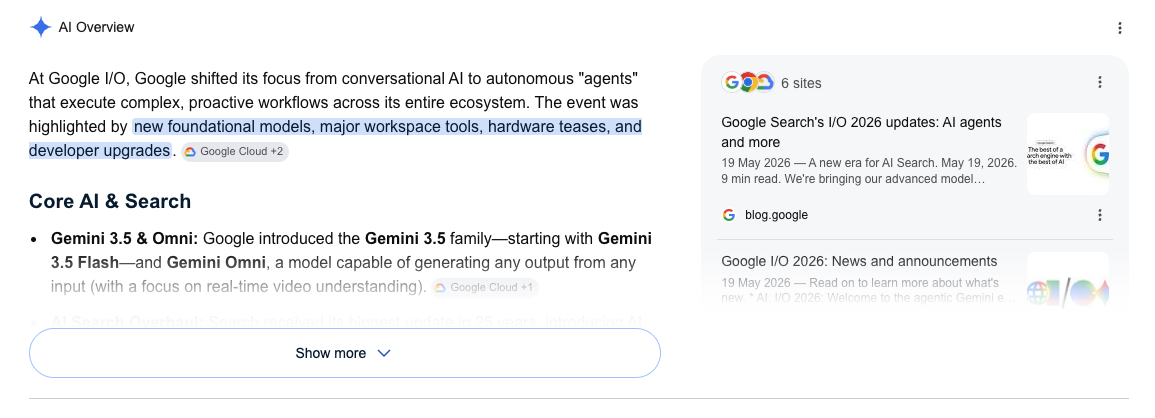
A typical AI Overview (AIO) displaying a summary and list of sources. Clicking on the ‘Show more’ takes you to AI Mode (AIM).
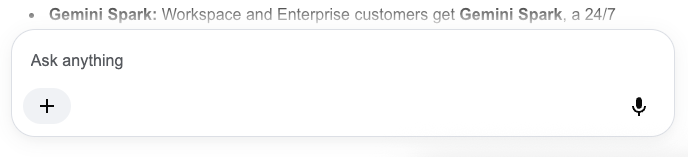
The AIM ‘Ask anything’ box moves the query on from traditional search into a chat format.
Whether you, me or anyone else likes it or not, AI-powered features are becoming a mainstay across almost every platform we use day to day. A top-down change like this has in turn driven a behavioural shift among us, with users feeling more comfortable than ever forming longer, more detailed, and more specific queries. And we’re not just typing these queries either, but increasingly asking questions to our LLM aloud, and dropping in images or videos when the situation requires. As a society we are also less reliant on ‘traditional’ sources for news or information - Instagram, TikTok and YouTube are considered by millions of people as fountains of knowledge (some of it questionable, mind you) but they are now drawn into the search ecosystem where a decade ago social media was viewed as a more frivolous online space. Basically, we have more tools at our disposal than ever before to help us get to our desired answer quicker and more efficiently, and boy are we using them.
So why wouldn’t Google also innovate for these changes? Personalisation on the web has been used for years in so many ways and by so many industries to create a more useful user experience, why not have a more personalised web search experience too?
Like keeping track of your subscriptions and following your favourite publications and creators so that when you run a Google search your trusted sources show up where they would not for someone else. Or the ability to customise what your search layout looks like with tailored apps or widgets that are relevant to you. Or even getting your LLM friend to search for things in the background and send you a notification when prices fall below your pre-assigned limit (I’m thinking about flights, obviously). It all actually sounds like something many, many people would find more useful than the current list of paid ads and other irrelevant bits of fluff taking up prime real estate on SERPs before those golden, sorry blue, links.
All of that to say that a change like this can inspire a knee-jerk reaction until you take the time to consider the pros and cons, and also accept that the change will happen whether you like it or not. What makes the difference in the long run is your resilience and how you adapt to changes that are beyond your control, instead of feeling bruised that everything can’t stay the same forever and ever and ever.
So change is coming, okay, what do I do now to make sure I keep up with it all?
First up, here’s what you don’t need to do: you do not need to optimise specifically for AI tools. We’ve said it before but we’re saying it again. Why? Because Google finally said it too and when Google speaks, we all listen.
It is not unreasonable to be concerned about AI models borrowing information from your website and summarising it in AIO or AIM or in any other chat scenario, I get it! Websites across every industry are experiencing a drop in traffic as a result of users finding answers without ever leaving Google (known as a zero-click search). But beyond that startling reality there is another truth that might help you sleep better at night: users that do land on a website after seeing it in an AI Overview or in an LLM answer generally spend a lot longer on that site and are more likely to convert. Think of it like weeding out the quality from the quantity.
In order to be one of those sources that is surfaced or cited in an AI answer, you need to focus on the sort of content you put out: Google is now calling this either commodity or non-commodity content, and you need to be focusing on the latter.
Commodity vs. Non-commodity Content
Commodity content refers to content that is essentially generic, easily summarised, often mass-produced, you get the idea. No unique angle, no first-hand data or insights. The sort of stuff that an AI model can easily produce and which leads to a zero-click search. Google has explicitly said they are deprioritising this content because the internet is awash with it so its relevance has been heavily diluted over the years. Bad news if all you publish are generic articles just for the sake of SEO, but hopefully you’ve not been doing that anyway.
So what is non-commodity content? We have been fortunate enough to receive clear guidance from Google themselves about what the defining features of non-commodity content are, namely: uniqueness, authenticity, specificity, and structure.
A unique point of view helps your content stand out, fact. Including first-hand experience or primary data leads to content that an AI model could not produce itself, nor could any of your competitors (because they are not you). Google also wants you to ensure that that content is “helpful, reliable, and people-first”, basing content on information that is common knowledge would be considered commodity content. Focusing on making sure what you’re saying hasn’t been said before and that what you’re saying is genuinely valuable to your audience has never ever been more important, so reflecting on what makes your point of view worth reading is essential.
Structuring your content, especially written copy, in a manner that is not only designed for humans but is written with your audience in mind is also essential for creating successful non-commodity content. Depending on the type of content, audiences can be expected to remain engaged for different lengths of time, so to try and keep everyone on the same page (pun intended), focus on the following:
make your writing engaging
get to the point/answer the question quickly (this has been shown to directly influence LLM citation rates)
create space for a summary for users who prefer to skim
structure your argument in a logical way
cite sources where needed
So there you have it. Not so scary after all, right? Without repeating ourselves again, the message really has stayed the same: be unique, be genuine, be authoritative, be trustworthy, be specific, be structured, be clear, be all the things that would make a customer want to buy from you. Don’t be reactive to clickbait headlines that say changes to how people search mean you have to throw your SEO strategy out of the metaphorical window. No matter what Google SERPs looks like in the future, the fundamentals that have always been important will continue to be important.
Google has been kind enough to spell out in no uncertain terms what to do in response to this changing landscape, and I think it's worth a direct quote to round this out:
“Focus on what your visitors would enjoy, find helpful, and feel satisfied with after visiting your website. If you’re ever unsure about a decision for your site, ask yourself: “Is this content that my visitors would find satisfying?” If the answer is yes, then you’re on the right track, as our systems are designed to connect people with exactly that kind of useful information.”
Google Speaks On Chunking, Site Signals, Content, Paywalls & AI Clicks - Barry Schwartz
Google On Publishing Commodity Content - Barry Schwartz
A new era for AI Search - Elizabeth Reid
Optimizing your website for generative AI features on Google Search - Google
Creating 'Non-Commodity' Content That Isn't Shit - Harry Clarkson-Bennett
What The Future of Google Looks Like - Harry Clarkson-Bennett
Google I/O *just* ended - Jess Joyce
It Works Until It Doesn't: AI Content Strategies That Backfire - Lily Ray
Google Launches Core Update Amid I/O AI Search Overhaul – Matt G. Southern
